

2026 Bathroom Remodel Cost Guide
Click here to read Chapter 3 summary
In the architectural and financial planning of a 2026 remodel, square footage is a baseline, but it is rarely the final word on cost. As the Lead Estimator at Trends Kitchen & Bathroom Specialists, I often explain to our clients that bathrooms possess the highest “Density of Cost” in the entire home. While a living room or bedroom may cost $50 to $100 per square foot to renovate, a high-end bathroom in 2026 can easily exceed $800 to $1,200 per square foot when you factor in mechanical systems and high-end finishes.
This chapter performs a granular dissection of costs based on the physical footprint of the space. We will examine the Powder Room, the Guest Bath, and the Primary Suite through the lens of “The Three-Dimensional Budget”—accounting for floor area, vertical wall area, and the volumetric requirements of modern 2026 mechanical systems.
3.1 The Powder Room: The “High-Density” Investment (20 – 35 sq. ft.)
The powder room is the most concentrated financial area of your home. Because there is no shower or tub, every dollar spent is visible. In 2026, the average cost for a professional powder room renovation in the Kansas City metro ranges from $6,500 to $14,000.
Vertical Real Estate and Wall Treatments
In a space this small, the walls are your primary canvas. In 2026, the market has moved away from simple eggshell paint toward “High-Tactile” and “Statement” surfaces.
- Custom Millwork and Architectural Carpentry: Installing decorative wood paneling, floor-to-ceiling wainscoting, or “slat walls” (a major 2026 design trend) adds roughly $2,500–$4,500 in specialized labor. These tasks require “finish carpentry” precision, which bills at a higher rate than standard framing.
- Luxury Wallcoverings: Commercial-grade, moisture-resistant vinyl or “grasscloth” wallpapers cost between $25 and $65 per yard for material alone. In a 30 sq. ft. room, the total wall area is often 120+ sq. ft., making professional installation a $3,000+ line item when you include the necessary wall-prep labor.
The “Statement” Vanity and Specialized Plumbing
- Wall-Mounted (Floating) Vanities: To make small spaces feel larger, 2026 designs utilize “floating” vanities. These require Structural Blocking inside the wall—a cost often missed by amateur estimators. You must factor in $600–$900 for the framing reinforcement and drywall repair before the vanity is even mounted.
- Vessel Sinks and Floor-Mounted Faucets: High-end powder rooms are increasingly utilizing floor-mounted faucets that rise like sculpture from the floor. This requires a plumbing “rough-in” through the subfloor and joists, which can add $1,500 to the plumbing labor compared to a standard wall-mount faucet.
3.2 The Full Guest/Hallway Bathroom: The Standard of Utility (45 – 65 sq. ft.)
The 5’x8′ bathroom is the most common layout in Kansas City suburbs. In 2026, the “Mid-Range” price for this space sits between $22,000 and $36,000. The financial complexity here is driven by the “Wet Area” (the tub or shower alcove).
The Anatomy of the 2026 Tub Alcove
- Cast Iron vs. Resin Tubs: In 2026, we are seeing a resurgence in Kohler cast iron tubs for their heat retention and lifetime durability. A premium cast iron tub costs $1,400, plus an $800 “heavy-lift” labor surcharge. Due to the 350lb+ weight, it requires a three-man installation team to navigate 20th-century Kansas City hallways without damaging the home’s structure.
- Vertical Tile Takeoff: A standard tub surround requires roughly 70–90 square feet of tile. If you choose 2026’s popular “hand-pressed” or “Zellige” tiles, the labor cost spikes because these tiles are irregular and require a “slow-set” installation method to ensure the lines are straight. Expect to pay $35–$45 per square foot for labor on specialty tile, compared to $18 for standard porcelain.
Flooring and Sub-Surface Infrastructure
In 2026, we strictly refuse to install tile over old plywood or greenboard. The professional “gold standard” requires an uncoupling membrane (such as DITRA).
- Membrane & Thin-set Cost: $4.50/sq. ft.
- Labor for Subfloor Leveling: $6.00/sq. ft.
- Total Flooring Investment: For a 50 sq. ft. bathroom, you are spending nearly $2,000 on prep before the first decorative tile is even buttered. This is “invisible money” that protects your floor from cracking during KC’s extreme seasonal temperature shifts.
3.3 The Primary Master Suite: The “Wellness Center” (80 – 150+ sq. ft.)
This is where the budget moves into the $50,000 to $110,000+ range. At this size, we are managing a complex ecosystem of mechanical systems, structural engineering, and high-end finishes.
The “Wet Room” Configuration and Engineering
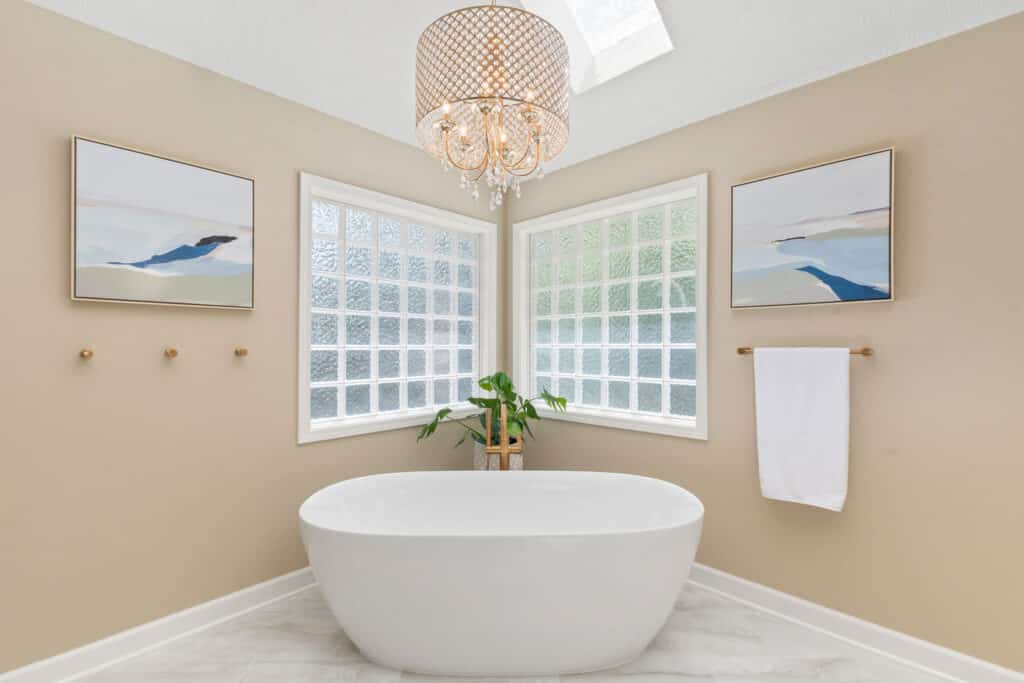
A hallmark of 2026 luxury is the “Wet Room,” where a freestanding tub is placed inside a massive glass-enclosed shower area.
- Full-Room Tanking: This requires “Tanking” the entire room. We must waterproof the floors and walls up to 72 inches across the entire footprint. This adds $4,500–$7,500 in waterproofing labor and membranes.
- Linear Drainage Systems: A room of this size often requires a Linear Drain to handle the high-volume water flow from multiple rainheads and body sprays. A high-quality 60-inch linear drain (like Schluter-Kerdi-Line) costs $900–$1,300 for the hardware plus specialized “pre-slope” floor-leveling labor.
The Dual Vanity and Electrical Infrastructure
In a master suite, we are almost always installing two separate vanity stations, often on opposite walls.
- Plumbing “Stack” Relocation: Moving the drains for a second sink across the room is a significant expense. In a house with a crawlspace, this is a $2,500 move. In a house on a concrete slab, it can exceed $5,000 due to the need for jackhammering and trenching.
- The 2026 Electrical Load: Modern master suites require dedicated circuits for:
- Radiant Floor Heating (15-20 amps)
- Steam Shower Generator (30-50 amps—essentially the same power as an electric oven)
- Smart Toilets (15 amps for heated seats and lids)
- LED-Integrated Defogging Mirrors (15 amps)
⚠️ CFO Warning: Most Kansas City homes built before 2005 have 100-amp panels. A 2026 Master Suite remodel will almost always trigger a Main Panel Upgrade, adding $4,500–$7,000 to the project total.
3.4 Volume vs. Surface: The “Z-Axis” of Budgeting
To provide a truly expert-level guide, we must discuss the Vertical Linear Foot. Most homeowners focus on the floor, but in a bathroom, 80% of your material and labor cost is on the walls.
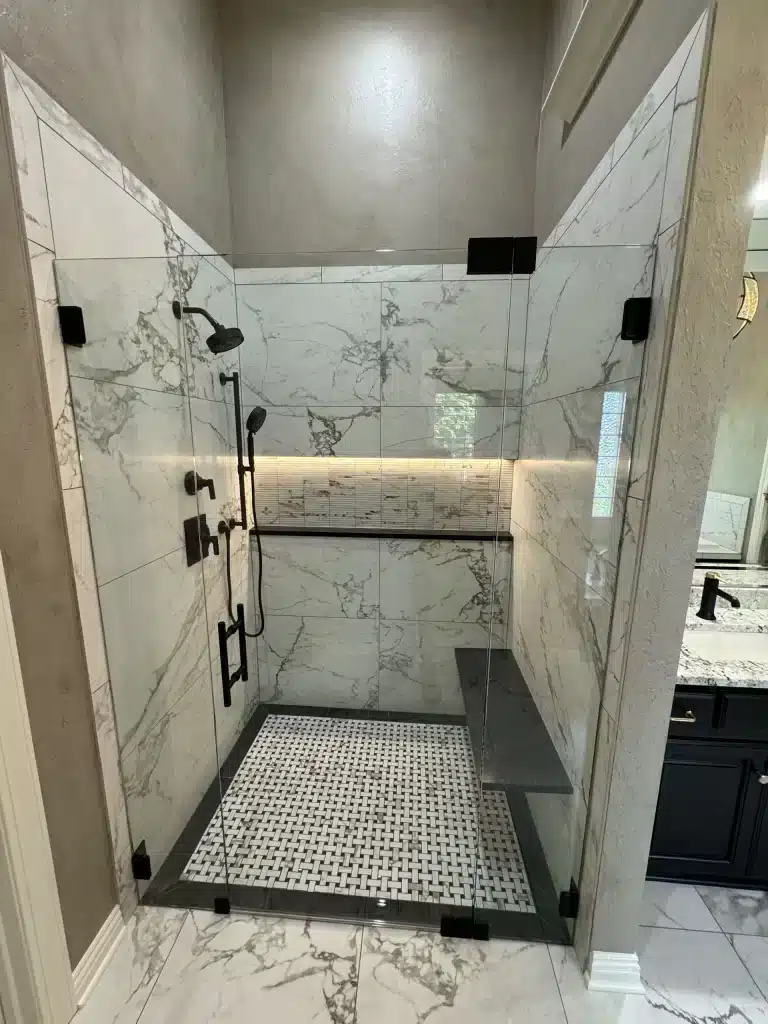
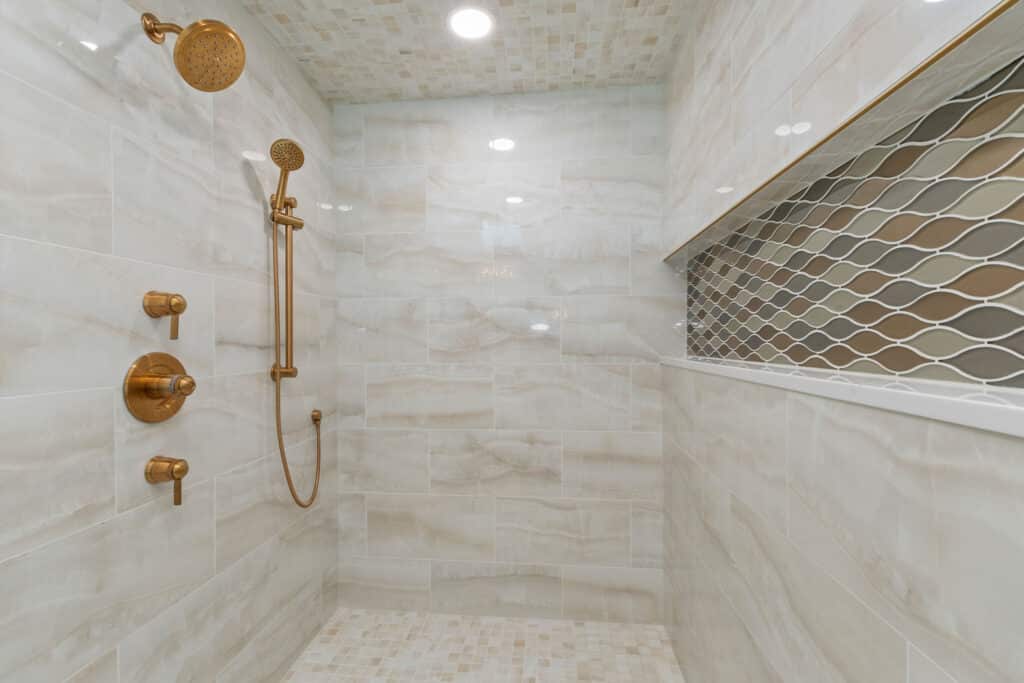
- Floor-to-Ceiling Tile: In 2026, taking tile to the 9-foot ceiling instead of stopping at the 7-foot showerhead adds approximately 40% to your tile budget. However, from a resale ROI perspective, it increases the “perceived luxury” of the home by 2x.
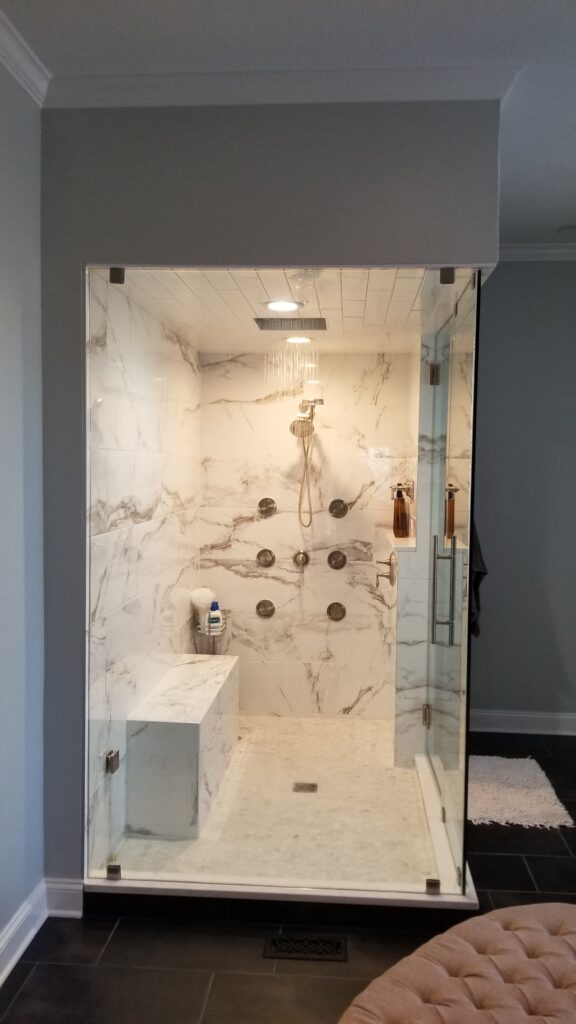
- Ceiling Waterproofing: If you install a steam shower, the ceiling must be tiled and sloped (to prevent cold condensation from dripping). This structural detail alone can add $3,500 to a shower build.
3.5 Regional Size Variations in the Kansas City Metro
The cost of square footage varies by the age of your KC neighborhood:
- Johnson County (Overland Park/Olathe): Large “McMansion” footprints from the 90s (120+ sq. ft.) often have “hollow” builder-grade finishes. The cost here is in the Demolition and Upgrade of massive surface areas.
- Historic Hubs (Brookside/Waldo/Plaza): These bathrooms are tiny (35–45 sq. ft.). The cost here isn’t in size—it’s in the Structural Challenges of 1930s plaster walls and cast-iron plumbing stacks that require a full “Re-Pipe” to be compatible with 2026 fixtures.
3.6 Summary of Investment by Size (2026 Estimates)
| Bathroom Type | Size (Sq. Ft.) | Investment Range | Primary Financial Driver |
| Powder Room | 20 – 35 | $6,500 – $14,000 | Custom wall finishes & carpentry |
| Standard Guest | 45 – 65 | $22,000 – $36,000 | Tub/Shower alcove & tile labor |
| Primary Master | 80 – 120 | $50,000 – $85,000 | Dual plumbing & electrical loads |
| Luxury Suite | 150+ | $90,000 – $130,000+ | Steam, saunas, & “Wet Room” engineering |
By understanding that cost is a function of both horizontal footprint and vertical complexity, you can better allocate your 2026 budget. Whether you are maximizing a tiny historic space or building a sprawling wellness retreat, Trends Kitchen & Bathroom Specialists uses dimensional data to ensure your estimate is as precise as the final tile cut.