
In the financial underwriting of a 2026 bathroom renovation, finish selection represents the exact operational point where long-term return on investment is either maximized or severely eroded. Data from the National Kitchen & Bath Association (NKBA) confirms a permanent structural departure from high-maintenance, cold clinical grays and disposable builder-grade plastics. Current capital allocation strategies prioritize a Lifecycle Asset Matrix, evaluating finish selections entirely by long-term durability, minimized maintenance overhead, and impact on terminal property value:
- Faucets and Fixtures (Matte & Brushed Over Polished): Industry indices show matte (54%), brushed (51%), and satin (46%) finishes completely eclipsing polished finishes (39%). Warm metallics (brushed gold, champagne bronze, gunmetal) utilizes high-performance Physical Vapor Deposition (PVD) molecular coatings to resist local hard water calcification and lime scaling. While requiring a 15% to 20% upfront procurement premium, their extended asset lifecycle and high resale “perceived luxury” yield a superior long-term ROI. Conversely, matte black remains a high maintenance liability in hard-water municipalities unless paired with whole-home water conditioning.
- Countertops and Slabs (Sintered Stone vs. Quartz): Luxury allocations have pivoted sharply toward sintered stone and ultra-compact surfaces. Impervious to thermal shock from styling tools, scratch-proof, and entirely non-porous, this material offers unmatched durability but commands an inherent 20% fabrication labor premium. The structural density requires slow-speed CNC routing and specialized diamond tooling, which must be accurately calculated to avoid severe budget variances.
- Vanities and Cabinetry (Biophilic Wood Over Paint): Solid, wood-faced vanities (62%) have overtaken painted finishes (53%). In the high-humidity, shifting climate of the Midwest, painted Medium-Density Fiberboard (MDF) joints present a volatile risk for moisture swelling and structural splitting. True risk mitigation favors furniture-grade, solid-core white oak, walnut, or rift-sawn oak protected by marine-grade sealants, lowering the Total Cost of Ownership (TCO) across a 20-year lifecycle.
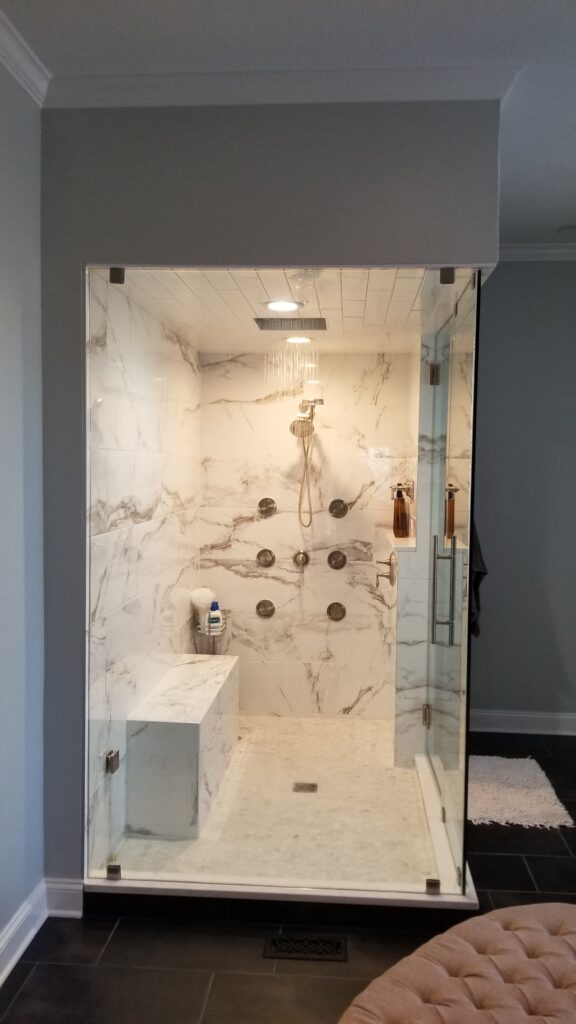
- Vertical Tile Drenching & The Zellige Surcharge: Modern architectural planning heavily relies on “Tile Drenching”—running large-format porcelain slabs (48″x96″ or 60″x120”) floor-to-ceiling to eliminate up to 90% of grout lines and eliminate long-term drywall maintenance liabilities. Conversely, specifying trending Moroccan Zellige or hand-pressed tiles triggers a severe labor multiplier. Due to intentional physical irregularities, they require meticulous, hand-set “butt-joint” installation, driving specialized artisan labor to $35 – $45 per square foot, compared to a standard $18 porcelain baseline.
Regionally, Kansas City operates as a central geographic logistics hub, yielding a 5% to 8% freight cost dividend on heavy natural stones and cast-iron fixtures. To optimize capital velocity, finish selection must strictly align with micro-market realities; utilizing baseline builder-spec materials within high-value Northland enclaves like Briarcliff, Weatherby Lake,Tremont, or The National actively depresses terminal value, whereas luxury PVD metals, white oak cabinetry, and sintered stone are mandatory benchmarks to command maximum equity retention.