
2026 Bathroom Remodel Cost Guide

Click here to read the Chapter 5 Summary
To the untrained eye, a luxury bathroom remodel is defined by its visible stone, gleaming fixtures, and frameless glass. To a professional estimator and seasoned builder, the true value of the asset is determined entirely behind the drywall. In 2026 construction management, plumbing is no longer a matter of basic utility; it is a highly calibrated exercise in hydraulic engineering.
When you install high-volume multi-jet systems, rain heads, and standalone soaking tubs, you change the volumetric and pressure dynamics of the entire property. If your mechanical infrastructure is under-engineered, your luxury finishes will perform at a deficit. This chapter performs a clinical evaluation of behind-the-wall plumbing systems, specifying the hidden standards required to protect your equity and deliver a flawless sensory experience.
5.1 Pressure-Balancing vs. Thermostatic Valve Engineering
The mechanical core of any 2026 shower footprint is the mixing valve. Most standard builders rely on basic pressure-balancing valves due to lower initial procurement costs. However, from a Total Cost of Ownership (TCO) perspective, pressure-balancing represents a long-term operational compromise.
- Pressure-Balancing Limitations: These valves maintain temperature by mechanically balancing the ratio of hot and cold water pressure. If an appliance cycles elsewhere in the home, the pressure drops, resulting in immediate temperature fluctuations.
- The Thermostatic Standard: High-end architectural standards in 2026 dictate Thermostatic Control Valves. Thermostatic valves utilize a heat-sensitive element that constantly monitors and self-adjusts the literal temperature of the water volume. It allows you to control the water volume and water temperature independently. You can turn the shower off and back on without ever losing your exact pre-set temperature configuration. For high-end primary suites, investing the 30% premium for thermostatic mechanical infrastructure is a non-negotiable benchmark for true asset luxury.
5.2 Volumetric Supply and the Multi-Fixture Deficit
A frequent failure point in amateur remodeling plans is specifying an advanced multi-fixture shower array while leaving the historic 1/2-inch supply lines intact.
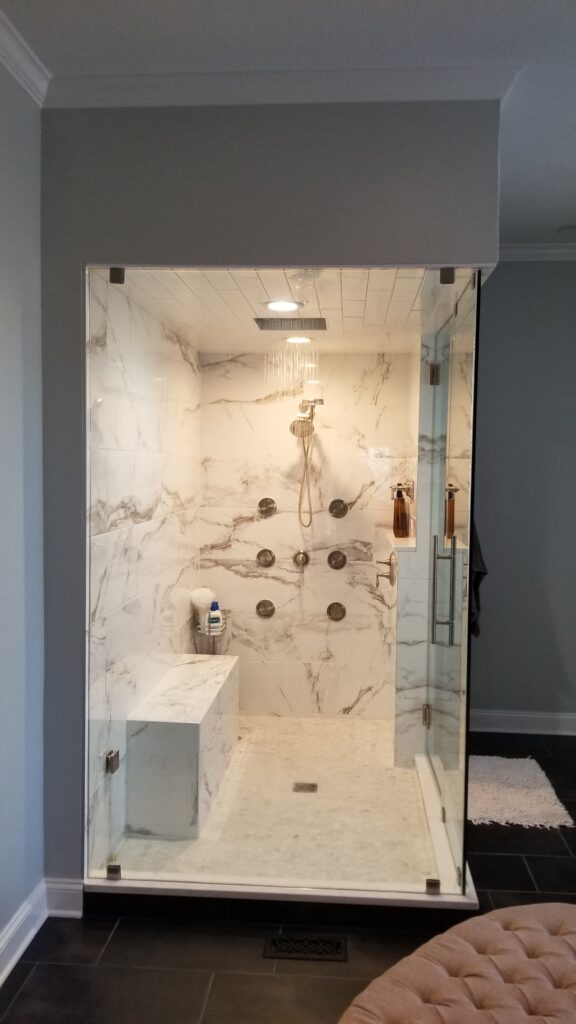
- The Math of Flow Rates: A standard 2026 showerhead operates at 1.75 to 2.5 Gallons Per Minute (GPM). If your master suite design incorporates a primary rain head, a secondary handheld sprayer, and dual body-jets, your simultaneous demand can easily scale to 6.0+ GPM.
- The Pipe Infrastructure Upgrade: A standard 1/2-inch copper or PEX supply line cannot physically deliver this volume without an aggressive drop in dynamic pressure. For luxury configurations, a reputable contractor will execute a full 3/4-inch main trunk supply line upgrade directly from the water heater to the shower manifold. This structural adjustment increases volumetric capacity by nearly 2x, ensuring every fixture fires at maximum therapeutic velocity simultaneously.
5.3 Signature Recessed Architecture: The Grand Infiniti Niche
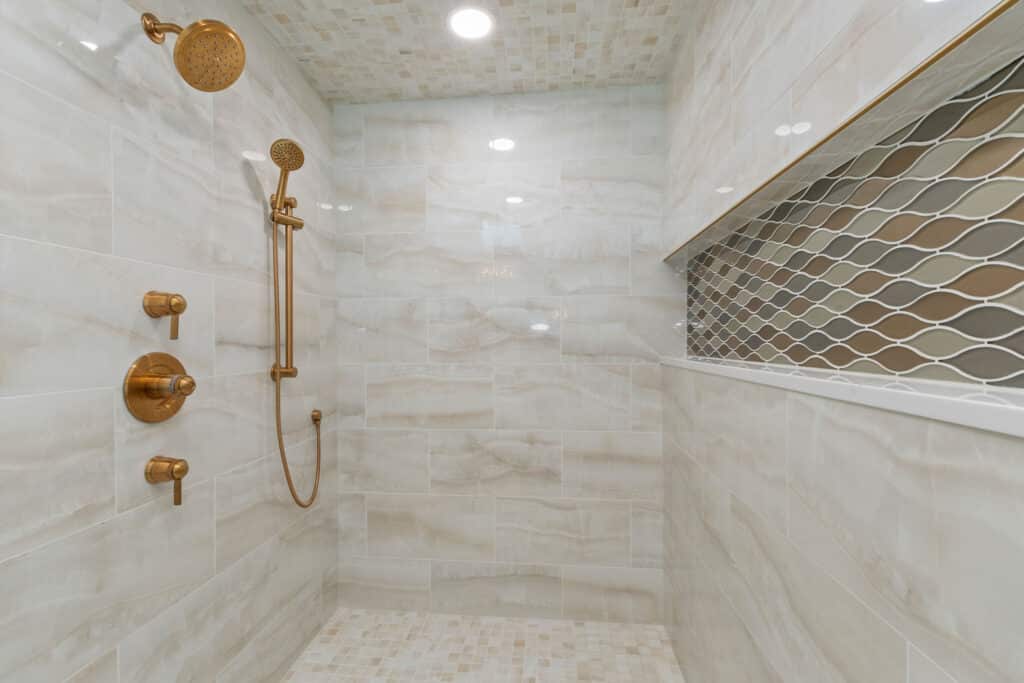
The evolution of horizontal shower storage has moved far past standard plastic corner shelves or basic square wall inserts. At Trends Kitchen & Bathroom Specialists, our signature hallmark for structural wet-area design is the Grand Infiniti Niche.
[Structural Cross-Section: The Grand Infiniti Niche]
================== Main Shower Wall Tile ==================
   [================= Recessed Quartz Slab =================]
   [   Integrated LED Track | Hidden Pre-Slope Drainage   ]
===========================================================
- Engineering the Footprint: A standard niche is framed between two standard studs, limiting your storage to a cramped 12-inch width. The Grand Infiniti Niche breaks past structural boundaries, stretching horizontally up to 48 or 60 inches across the entire expanse of the wet area or directly over a standalone soaking tub. This requires structural header modifications inside the framing—a task that demands precision finish-carpentry execution.
- Waterproofing and Material Integration: The interior lines of our Infiniti Niches are lined with solid quartz or sintered stone slab fragments rather than standard pieced tile, completely eliminating interior horizontal grout lines. Built with a mandatory, invisible 1/16-inch forward pre-slope, it ensures water naturally sheds back into the shower pan rather than pooling inside the wall cavity, mitigating 100% of long-term moisture and mold liabilities.
5.4 Advanced Drainage Dynamics: Linear vs. Point Drains
To achieve a true flush-entry or curbless wet room design—a major structural goal for luxury properties in 2026—the traditional center point drain must be replaced by advanced linear drainage engineering.
- The Curbless Barrier: A standard center drain requires a 4-way slope, forcing the tile installer to cut decorative tiles into awkward triangles to pitch the floor toward the center.
- The Linear Advantage: Utilizing a continuous linear drain system (such as Schluter-Kerdi-Line) requires only a single, uniform one-directional slope toward the wall. This allows for the uninterrupted installation of large-format porcelain tile sheets right across the shower floor floorbed. The hardware requires specialized pre-slope mud-bed leveling or pre-engineered foam tray sloping, but it completely removes the physical trip hazard of a shower curb, enhancing accessibility and increasing your home’s universal design value.
5.5 Regional Water Nuances and Asset Protection
Protecting your high-end solid-brass plumbing valves against regional environment variables is a vital step in your capital management blueprint:
- The Hard Water Tax: The Kansas City municipal water supply contains high baseline mineral counts that can cause internal calcium scaling within complex thermostatic cartridges.
- The Value Mitigation Strategy: When executing high-end master transformations in target premium sectors like Briarcliff, Weatherby Lake, or Tremont, we strongly advocate for the integration of a whole-home water conditioning system or a targeted inline sediment filter right at the main mechanical trunk. Removing these minerals before they enter your solid-brass rough-in valves protects your fixture warranties and keeps your infrastructure running cleanly for decades.