
2026 Bathroom Remodel Cost Guide


Click here to read Chapter 7 Summary
A signed contract, a stack of premium materials, and a beautiful design rendering are completely meaningless without an exact, military-grade Order of Operations. In residential asset underwriting, a bathroom renovation represents one of the most volatile scheduling environments in the entire home. Within a physical space often measuring less than 100 square feet, your general contractor must seamlessly coordinate up to eight different specialized trade disciplines.
If your project sequence skips a single critical step, or if trades are piled on top of each other prematurely, you trigger a cascading failure event. The results are immediate: compromised material warranties, structural vulnerabilities, and expensive change orders that aggressively erode your capital efficiency. This final chapter delivers the definitive project manager’s blueprint for the field-proven construction lifecycle, ensuring your remodel achieves absolute structural success.
7.1 The Chronological Sequence: Bathroom Order of Operations
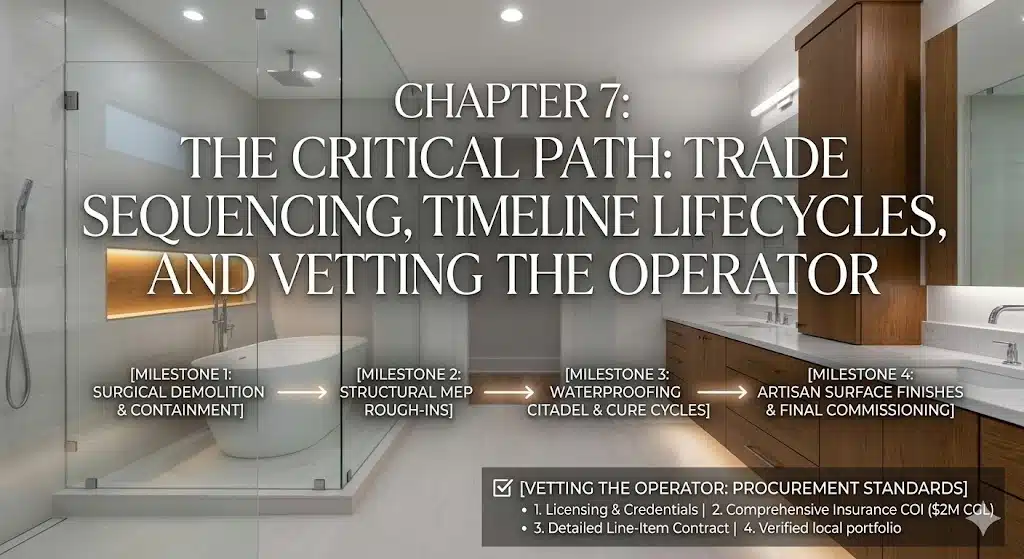
In the construction sector, scheduling efficiency is dictated by the Critical Path Method (CPM). Certain tasks can run parallel to one another, but the majority of bathroom phases are strictly dependent on the completion of the phase immediately preceding them.
When analyzing a project schedule from a top-tier design-build firm, execution must flow across five distinct, non-negotiable operational phases:
Phase 1: Isolation, Containment, and Surgical Demolition
- The Process: Before a single tool is drawn, the structural asset must be protected. This involves installing heavy floor protection boards (such as Ram Board) along the entire traffic pathway and erecting negative-pressure plastic dust containment walls over doorways to protect indoor air quality.
- The Demo: Demolition must be complete down to the naked structural wall studs and subfloor joists. Bypassing a full gut to “save money” is a severe operational risk; a full exposure is the only mechanism available to inspect the home’s hidden framing for historical water rot, active mold colonies, structural deflection, or compromised subfloors.
Phase 2: Structural Framing and MEP Rough-Ins (First Fix)
- The Process: Carpentry crews execute structural leveling, true up bowed wall studs (critical for large-format tile alignment), and install hidden structural framing blocks for wall-mounted vanities and your horizontal Grand Infiniti Niche.
- The Mechanicals: Once the skeleton is square, the mechanical sub-trades deploy. Plumbers install behind-the-wall solid-brass thermostatic valves and route 3/4-inch PEX supply trunks. Electricians pull home-run lines for dedicated 20-amp radiant floor heating circuits, heavy steam generators, and smart vanity automation.
Phase 3: The Waterproofing Citadel and Technical Cure Cycles
- The Process: The most critical phase for long-term risk mitigation. Crews install cement backer boards or rigid foam waterproofing panels. Subfloors are leveled using high-flow self-leveling underlayments, followed by the application of uncoupling crack-isolation membranes (DITRA).
- The Non-Negotiable Window: Homeowners must understand that advanced topical waterproofing systems (such as Schluter-Kerdi or Laticrete Hydro Ban) require absolute, uninterrupted chemical cure windows. Forcing a tiler to lay decorative stone over a membrane that hasn’t fully cured voids the manufacturer’s performance warranty and guarantees sub-surface structural failure.
Phase 4: Artisan Surface Finishes and Grout Systems
- The Process: Tile artisans map out geometric alignments to prevent awkward corner cuts. Large-format porcelain sheets or artisanal hand-pressed Zellige tiles are slow-set manually to ensure perfectly flush joints.
- The Finish: Once the mortar completely sets, fields are packed with high-performance, stain-resistant epoxy or urethane grouts rather than cheap cementitious products that absorb moisture and degrade over time.
Phase 5: Mechanical Second-Fix, Custom Glass, and Final Commissioning
- The Process: Cabinet crews mount custom white oak or walnut vanities, and fabricators cut templates for sintered stone or quartz countertops. Plumbers and electricians return to install finish trim plates, mount smart toilets, hang fixtures, and hook up smart mirrors.
- The Closing Loop: Technicians conduct laser measurements for custom frameless shower glass doors (which can only be measured after final tile and grout are fully placed). The process concludes with a full, multi-hour hydrostatic pressure test of all plumbing assets and a thermal imaging scan of the radiant flooring system to certify baseline performance.
7.2 Underwriting the Operator: Vetting Your General Contractor
The residential remodeling market contains an aggressive spectrum of operational capability. To guarantee your capital is deployed with absolute security, a homeowner must move past charismatic sales pitches and audit prospective contractors using strict corporate procurement standards.
When vetting an operator, verify these four operational benchmarks:
- Licensing and Jurisdictional Credentials: Ensure the principal builder holds a valid Class A, B, or C contractor’s license, alongside specific business licenses required by local municipal codes to operate legally.
- Comprehensive Risk Insurance: Never accept a generic verbal assurance of coverage. Mandate the delivery of a current Certificate of Insurance (COI) sent directly from the builder’s insurance agency. The policy must clearly display a minimum of $1,000,000 to $2,000,000 in Commercial General Liability, paired with active Workers’ Compensation coverage to insulate your personal property from injury liabilities.
- The Detailed Line-Item Contract: High-caliber specialists lead with radical financial transparency. Completely reject lump-sum “ballpark” quotes that bundle labor and materials into a single mysterious number. A professional agreement itemizes exact costs across specific sectors: structural framing, subfloor prep, waterproofing membranes, specialized trade labor hours, and specific material allowances.
- The Verified Project Portfolio: Demand physical documentation of recently completed local transformations that match your intended scope. A reputable firm will confidently connect you with past clients who can verify their cleanliness, trade communication, and ability to hit schedule deadlines without invoking budget variances.
7.3 Conclusion: The Seven Pillars of Bathroom Capital Management
You have officially traveled through the entire structural layout of modern bathroom underwriting. By completing this guide, you have moved from a standard real estate consumer to an advanced Capital Manager of your home’s most dense and complex interior asset.
True home equity value is never built by cutting corners, chasing the lowest bid, or prioritizing cheap, superficial aesthetics over behind-the-wall infrastructure. Long-term value retention is anchored entirely by material science, technical precision, operational discipline, and hiring elite, transparent craftsmanship. When you lead your project with clear data and structured execution, your home’s private wellness sanctuary will seamlessly deliver absolute personal comfort while firmly securing your financial terminal value for the next quarter-century.