
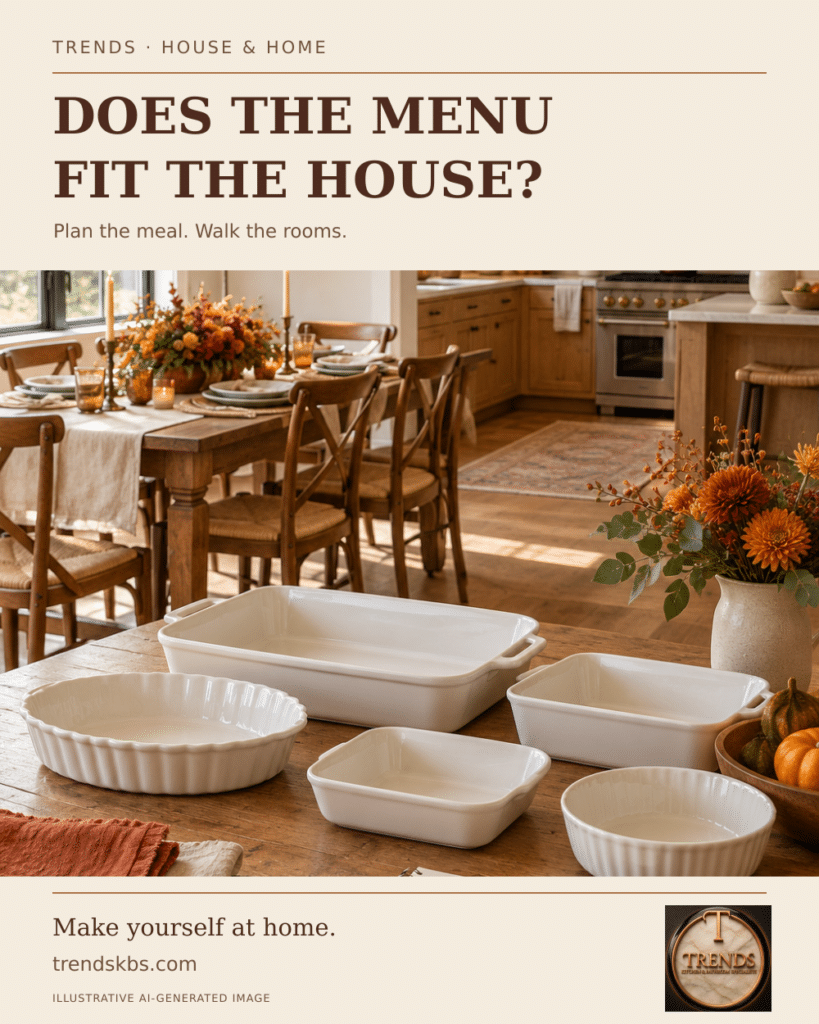
TRENDS HOUSE & HOME · FOOD, FAMILY & TRADITION
A Thanksgiving menu can fit on a sheet of paper. Getting it through the house takes more planning.
The make-ahead side dish still needs a place in the refrigerator. The casserole needs the oven. The punch needs a serving spot. And after everybody eats, the plates, pans and leftovers all come back toward the sink.
Up in Kearney, the Fun Farm Fall Festival runs through Sunday, November 1, so there is still time for one more trip to the pumpkin patch before the holiday planning takes over.
For more of what’s happening around Kansas City, see our live events calendar.
Look at the menu as a route through the house. Each dish needs somewhere to wait, somewhere to be prepared and somewhere to be served. Working that out before the holiday can show you what to rearrange now and what might deserve a longer-term change.
Quick read
Assign every course a storage spot, a preparation area and a serving location. Check actual pans and dishes against the space available. Keep guests out of the hot-food route. Plan the return trip for dirty dishes and leftovers. Adjust the menu or the setup when the house cannot comfortably handle both.
Start at the front door
Dinner planning starts before anybody reaches the kitchen.
Guests arrive carrying coats, bags and sometimes a dish that needs attention. If there is nowhere obvious to put anything, the kitchen counter can become the landing zone for all of it. Then the surface you intended to use for dinner is occupied before dinner gets going.
Choose a place for personal belongings away from food preparation. Clear the path from the entry to the gathering area. Decide where an arriving dish should go, and tell the person bringing it whether you need it ready to serve or whether you have agreed to provide storage or reheating space.
That last detail matters. “Bring a side” leaves a lot unanswered. A finished salad and a cold baking dish that needs oven time ask very different things of the house.
Give the refrigerator a real assignment
A make-ahead menu moves work out of Thanksgiving morning. It also moves more dishes into cold storage beforehand.
Before shopping, look at the containers you plan to use. A wide casserole dish may take up a shelf even when the refrigerator looks mostly empty. Tall bottles and serving bowls may compete for the same adjustable space.
Clear out what no longer belongs there, clean the shelves and group the ingredients for each dish. Keep raw ingredients appropriately contained and separated from ready-to-eat food. Follow current food-safety guidance for storage and handling; this article is about organizing the space, not changing food-safety requirements.
Do not count an unheated porch or garage as refrigerator capacity. Outdoor temperatures change, and a cold-feeling room is not controlled storage. If you need additional refrigeration, make sure the appliance and its location are suitable for that use.
Plan for the return trip as well. After the meal, leftovers need appropriate containers and timely storage. A refrigerator packed to its limit before dinner leaves you another problem afterward. Set aside suitable containers and think through that space before you fill every shelf.
The pantry has a job, too
Dry ingredients, unopened drinks and serving supplies do not all need to sit on the kitchen counter.
Group the items you will use together and put everyday items back where they belong. Check what you already have before buying more. A shelf of duplicate supplies can make the pantry feel too small even when the bigger issue is that nothing is easy to find.
Move backup napkins, extra cups and unopened serving supplies near the room where they will be used, if you have a suitable place. Keep heavy items stable and accessible. Avoid turning a hallway or stair landing into overflow storage.
The goal is to make the next thing easy to retrieve without unpacking everything in front of it.
Walk the oven and cooktop through the menu
Write down what needs each appliance and when. Include dishes arriving with guests.
You are looking for overlap. Several foods may need the oven at the same time, in different pans or under different cooking instructions. A pot may fit on a burner by itself but leave awkward access to the one behind it. The question is whether the actual equipment and dishes work together.
Check the pans against usable appliance space while everything is cool. Follow the appliance instructions for rack positions, clearances and cookware. Do not assume a pan fits just because its listed size sounds smaller than the oven.
If the plan does not fit, change it before the holiday. Choose a dish that does not compete for the same equipment, arrange for a guest to bring something ready for its next step or reduce the number of dishes. Follow appropriate food-handling guidance when planning any preparation ahead of time.
Another appliance is not automatically the answer. It needs a suitable location, proper power, safe clearance and room for handling what comes out of it. A temporary appliance squeezed into the last open corner may take away the very work surface you need.
Put the preparation area back to work
Counter space has to handle more than ingredients. It needs room for the tools you use, dishes waiting for their next step and safe handling around hot cookware.
Clear decorations and equipment that will not be used. Group supplies for the current task instead of putting every course out at once. Decide where used utensils go so they do not spread across the entire surface.
Then look at who will be working there. If somebody is helping, give them a useful task in a place where they can do it without repeatedly crossing behind the person at the stove. A separate table may be useful for a task that does not need heat, water or electrical equipment.
Do not put a folding table in a location that blocks circulation, and do not assume a temporary surface can carry any load. Stability, surface suitability and access matter as much as the extra area.
Move serving out of the cooking line where possible
Think about the meal as separate activities: finishing the food, serving it, getting a drink and sitting down.
If all four happen around one island, the room may become congested even when the island is large. A serving area outside the main work path can help, provided it is stable, suitable for the dishes and reachable without blocking a doorway.
Set out the empty serving pieces ahead of time. Include utensils and somewhere a person can safely set down a plate if needed. This shows you whether the arrangement works before you are carrying hot food.
The dining table has its own limits. Decide whether it needs to hold serving dishes or whether those will stay elsewhere. Keep decorations low and compact enough for people to talk, see and use their place settings. Pull chairs out and walk behind them. A table can fit in a room while leaving very little space for people to use it.
Dessert does not have to arrive with dinner
A dessert and coffee setup can wait until the main serving area is cleared, or it can use another suitable location if you have one.
Keep the backup dishes and cups close to where they will be needed. If coffee equipment moves out of its usual spot, check that the surface, outlet and cord arrangement are suitable. Do not let a convenient display create a hot-drink hazard or a blocked walkway.
Giving this course its own place in the plan can free up space earlier in the day. It also gives someone helping you a clear task: set up that area when the room is ready for it.
Plan what comes back to the sink
After dinner, the route reverses. Plates come off the table, pans come off the serving surface and food needs to be put away.
Choose where dishes will land without blocking the sink or the refrigerator. Make sure the dishwasher can open without trapping somebody in the cleanup area. Set out the containers you intend to use rather than searching for matching lids with a full counter.
Not every pan belongs in the dishwasher, and not every dish fits the rack. Check the care instructions and plan some handwashing where needed. Do not put a gathering’s worth of food scraps down the sink as a shortcut.
If an appliance or drain already has a recurring problem, include that in the preparation list. A bigger meal does not fix it. Address the known problem rather than building the day’s cleanup around hoping it behaves.
Turn the menu into a short house checklist
For every course, answer these questions:
- Where will its ingredients or prepared containers wait?
- What equipment and work surface will it need?
- What else needs that space at the same time?
- Where will people serve it without blocking preparation?
- Where will the dishes and leftovers go afterward?
The answers may lead to a smaller menu, a cleared cabinet, a moved drink station or a better conversation with the people bringing food. Those are useful improvements without construction.
If the same limitations show up in everyday life as well as at Thanksgiving, keep a specific list. “The kitchen is too small” does not tell us much. “The dishwasher blocks the passage,” “the refrigerator has no landing space” or “guests stand where we carry hot pans” gives us something concrete to work on.
For the rest of the house, read Getting Your Home Ready for Holiday Guests. And if you are still deciding what to bring, The Thanksgiving Side Dish That Takes You Home is a good place to start.
If your holiday plan keeps running into the same limits in the house, message us with that list and we can talk through the options.
Trends Kitchen & Bathroom Specialists