
TRENDS HOUSE & HOME · FOOD, FAMILY & TRADITION
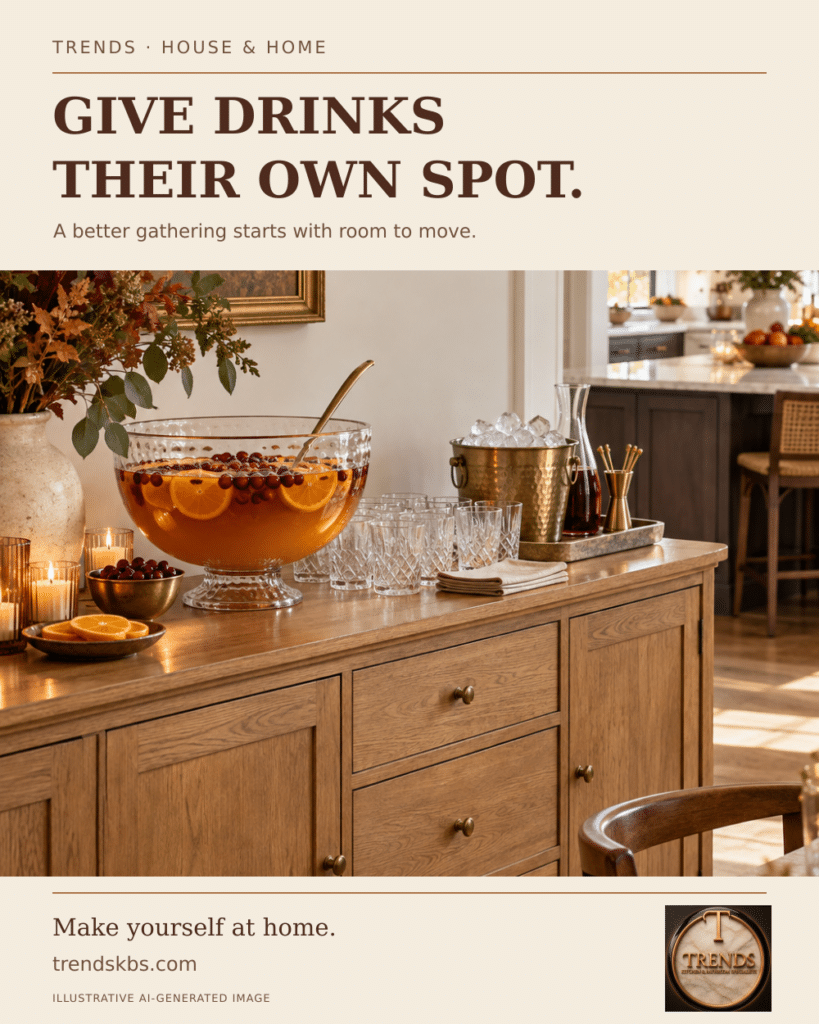
A bowl of Thanksgiving punch looks good in a picture. Put it beside the cutting board, the hot pans and the spot where everybody walks into the kitchen, and it becomes another thing you have to work around.
Today is homecoming at North Kansas City High School, with the parade from 2 to 3 p.m. and the football game at 7. If a crowd heads back to your place afterward, the drinks are usually the first thing everybody goes looking for.
For more of what’s happening around Kansas City, see our live events calendar.
The drink itself is only part of the setup. People need somewhere to set a glass, reach the ice and step aside while the next person pours. A drink station should let guests help themselves without sending them through the middle of dinner preparation.
Quick read
Put drinks outside the cooking path. Set out the actual containers before deciding whether a surface is big enough. Give wet items a washable landing area. Keep cords and hot equipment out of traffic. Try a temporary setup before paying for permanent cabinets, plumbing or refrigeration.
Start with the route through the room
Before deciding what goes on the counter, look at where people will stand.
Imagine somebody filling a glass while another person opens the refrigerator. Then imagine the oven door coming down and somebody carrying a dish toward the dining table. If those movements all need the same piece of floor, that is a poor place for the drinks.
The end of a counter can work, provided guests can reach it without stepping into the cooking area. A dining-room sideboard can work. So can a sturdy table just outside the kitchen. Being a little farther from the sink may be worth it if the location keeps people out of the way of hot food.
A narrow hallway usually gives you the opposite problem. The surface may be available, but a person stopping to pour can block everybody else. Keep doorways, stairs and the route out of the room clear. A cart is useful only if it sits securely and leaves a usable passage around it.
You do not need to guess. Stand in the proposed spot with the refrigerator, dishwasher and nearby cabinet doors open. That simple check can rule out a location that looked fine with everything shut.
Lay out the equipment, not just the decoration
There is no single counter length that makes every drink station work. A punch bowl, a coffee maker and a collection of cups take up very different amounts of room.
Bring out the things you actually plan to use. Include the tray, the ice container, the glasses, the napkins and anything people will add to their drinks. Leave a clear landing spot for a glass while someone handles a lid or uses the ice scoop.
If everything fits only when the items touch each other, the arrangement is too crowded. Remove something, move backup supplies into storage or use a larger surface. Do not solve a space problem by putting a heavy dispenser on the edge.
Decorations get the space that remains after the station works. A little fall color is plenty. Guests should be able to see what they are pouring and reach it without moving a centerpiece.
Think about the person refilling it, too. A large bowl may fit beautifully but be awkward to lift when full. Consider how you will fill, move and empty the container before committing to its location.
Give water somewhere sensible to go
Ice melts. Glasses sweat. Somebody misses the cup. Plan for ordinary use rather than a picture-perfect arrangement that stays dry only if nobody touches it.
Use a stable tray or another suitable washable surface under wet items. Check that anything placed on a wood finish will protect it; a damp towel can hold moisture against the finish instead of solving the problem. Keep the ice container steady and give the scoop a clean place to rest.
Put a waste container where guests can find it without opening every cabinet. Keep a cleanup cloth available. Neither needs to be the centerpiece of the display, but both should be easy to reach.
A nearby sink makes refilling and cleanup easier. That does not mean a temporary station needs its own plumbing. Carrying a small tray back to the kitchen may be a reasonable tradeoff for keeping the gathering area open.
Cold storage is a separate decision
A station can be away from the refrigerator, but someone still needs a plan for replenishing it.
Ask where the extra bottles, cans and ice will wait. If guests have to open the main refrigerator repeatedly, they may still end up in the cooking path even after you moved the serving table. A suitable cooler positioned out of the walkway can help with a temporary gathering. It also needs a dry, protected location and a manageable refill routine.
A beverage refrigerator can make sense in a room that gets regular use. Before buying one, check the appliance’s installation instructions, ventilation requirements, door swing and intended location. An appliance that fits between two cabinets is not automatically approved to operate there.
Think beyond the holiday. If the refrigerator would mainly store drinks for a few gatherings, compare that benefit with the cabinet space it consumes, the electricity it uses and the maintenance it adds. If your household would use it throughout the week, the calculation may look different.
An outlet matters only if the setup needs power
A cold punch station may need no electricity at all. Adding coffee equipment or another powered appliance changes the setup.
Choose a location where the appliance can be used according to its instructions without running a cord across a doorway or a walking path. Keep electrical connections away from the wet serving area. Do not make a temporary station depend on a chain of adapters or power strips.
An outlet on the wall does not tell you what else shares that circuit. If equipment causes repeated trips, stop using that arrangement and have the electrical needs evaluated. A permanent beverage area should have its power requirements planned with the equipment, rather than addressed after the cabinets are installed.
Hot drinks also need a stable surface, room to handle the container and placement that keeps hot equipment and cords away from children. If one table cannot provide that safely alongside cold drinks, separate the setups.
Make it easy to understand
Guests should not need a tour of the station.
Put cups near the beginning of the serving area, drinks where they are easy to reach and napkins where a person can grab one without reaching over a full glass. Keep backup cups and unopened supplies nearby instead of stacking everything on top.
If you are serving both alcoholic and nonalcoholic drinks, label them clearly. Give the nonalcoholic option a convenient place, rather than hiding it behind the main display. The point is to let people make their own choice without asking the host to explain every container.
Consider who will be using the station. Heavy lids, deep reach distances and crowded surfaces can make a simple task difficult. Move the commonly used items closer to the front and provide help with anything heavy or hot.
Choose the least complicated setup that solves the problem
A tray on an existing sideboard is worth trying first. It uses furniture you already own and shows you whether the location works. The limitation is capacity: there may not be enough room for every drink and all the backup supplies.
A freestanding cabinet or cart adds storage and can serve other purposes between gatherings. Check its stability, surface care and position in the room. Furniture does not become a wet bar simply because it has a countertop; it may not tolerate repeated moisture or support the equipment you want to put on it.
A built-in beverage area can bring storage, a suitable work surface, planned power and, when justified, a sink or refrigerator into one location. It also takes space from something else and brings installation work. Plumbing, ventilation, electrical needs and the way the room is used all belong in that decision.
I started in home construction in 1989, hanging sheetrock. After 16 years remodeling in Kansas City, the question I want answered before a cabinet layout is settled is straightforward: what does this space need to do? For a drink station, that means serving people, storing what you use and letting the rest of the kitchen keep working.
Give the temporary version a trial run
Before guests arrive, set out the station and walk through making a drink. Then walk through preparing and carrying dinner while somebody else stands there.
Look for the small problems: no place to put down a glass, a refrigerator door that hits the table, cups that require reaching over the punch bowl or a refill route through a crowd. Those are easier to fix before the gathering.
Afterward, write down what worked. If moving the drinks solved the traffic problem, you have useful information for the next holiday. If you still ran out of storage or had nowhere convenient to rinse and refill, you have a clearer starting point for a permanent change.
Hosting overnight guests too? Read Getting Your Home Ready for Holiday Guests. If the kitchen itself keeps getting in the way, our complete kitchen remodeling guide walks through the options at a more deliberate pace.
If a drink station keeps exposing the same problem in your kitchen, message us and we can talk through what the room needs.
Trends Kitchen & Bathroom Specialists