
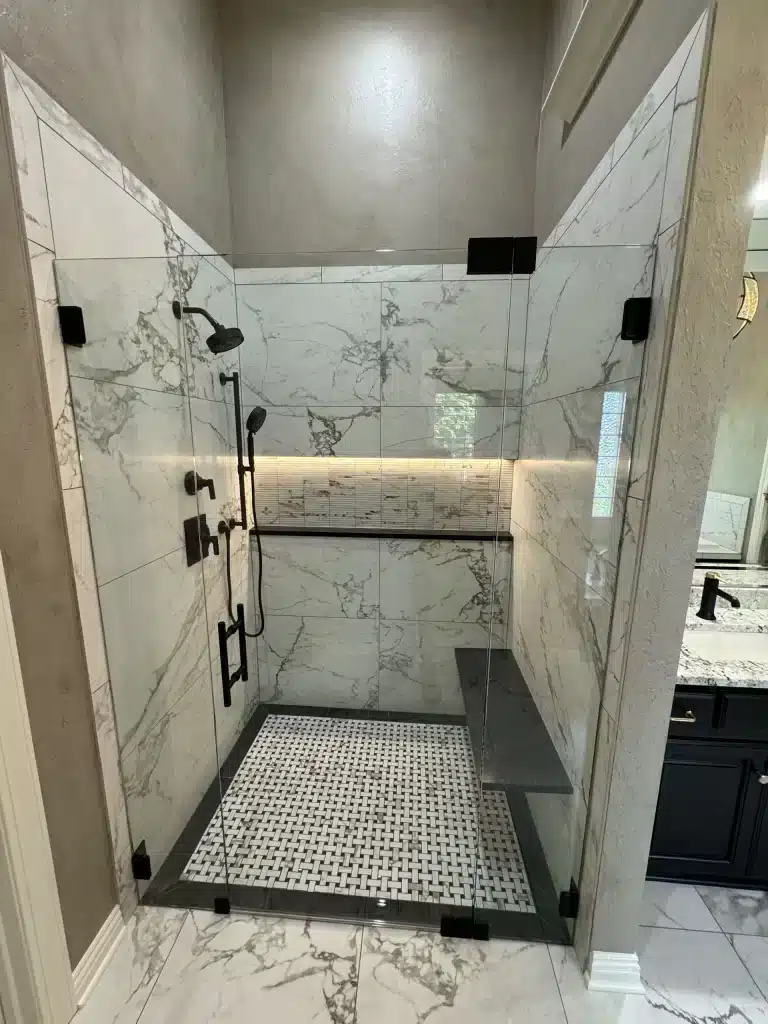
In 2026, bathroom remodeling across the Kansas City metro has bifurcated into a clear capital improvement strategy rather than standard home maintenance. Navigating this current economic landscape requires moving past flat-rate ballpark figures and analyzing real-world line-item allocations. According to current data from the National Kitchen & Bath Association (NKBA) and regional builders, local projects fundamentally fall into three distinct macro-investment tiers:
- The Cosmetic Refresh ($6,500 – $12,500): Often executed as a “Pull and Replace” footprint, this tier prioritizes high-visibility cosmetic upgrades (such as vanities and premium finishes). It commands the highest immediate percentage of resale ROI (80-90%), making it the most efficient use of capital for preparing a $300k–$450k home for a quick sale.
- The Mid-Range Transformation ($22,000 – $38,000): The suburban benchmark involving complete down-to-studs demolition and wet-area reconfigurations. Labor accounts for roughly 55% of this budget due to advanced subfloor prep and certified waterproofing requirements (like Schluter-Kerdi). This tier acts as the equity “sweet spot,” lowering the Total Cost of Ownership (TCO) via 20-year material durability.
- The Luxury Wellness Suite ($50,000 – $100,000+): Structural redesigns focused on integrated wellness technology (steam showers, radiant flooring, and smart automation). Driven heavily by complex Trade Sequencing and professional project management, these projects establish an “Alpha Property” status that creates a significant competitive advantage in elite enclaves like Leawood or Liberty.
Ultimately, value retention is determined by “Invisible Infrastructure.” Our extreme Midwest freeze-thaw cycles require allocating a premium to subsurface anti-fracture membranes and high-grade thin-sets to prevent structural grout failure during 100°F summers and -10°F winters. To successfully underwrite your investment, your budget must align directly with your home’s neighborhood Terminal Value.