
TRENDS HOUSE & HOME · FOOD, FAMILY & TRADITION
The door opens and the first guests arrive with coats, a bag, muddy shoes and a dish they were told not to worry about bringing. Someone reaches for the casserole. Someone else points toward the bedroom. Before long, fifteen coats are piled on a bed and the entry has become a place everybody has to step around.
The coat pile may be familiar, but it does not have to control the whole arrival. A useful entry gives people somewhere to pause, somewhere to put their things and a clear route into the house. Most of that starts with preparation, not new cabinetry.
The Kansas City Holiday Boutique opens November 18 at the Overland Park Convention Center and runs through November 22. As holiday outings and visits fill the calendar, take a look at what comes through your own front door with every guest.
For more of what's happening around Kansas City, see our live events calendar.
Quick read: Clear real space in the closet, choose a stable overflow option and separate coats from food arriving with guests. Give wet shoes a suitable place, check lighting after dark and keep doors, stairs and hallways open. Consider a permanent mudroom improvement only after identifying the problem that repeats all year.
Clear the closet before company arrives
Open the entry closet a week ahead. If it already holds every coat the household owns, the vacuum, sports equipment and a stack of packages, it is not ready to receive anything. Move the items that do not need to be there to a suitable temporary home rather than compressing the whole pile farther into the back.
Leave usable hangers and space between them. A coat that can technically be squeezed onto a rod may still be hard to find without pulling three others down. Consider the full length of the garments, not just the space at shoulder height. A long coat should not have to sit in a pile of shoes at the bottom.
Make the plan easy to explain. “Coats go here” works better than giving each arriving guest a tour of three possible closets. If there is an overflow location, decide it now and keep the route to it clear. The person greeting guests should not need to solve storage while holding a hot casserole.
An overflow rack can help if it belongs somewhere
A temporary garment rack may be useful for a larger gathering, but it needs a stable location outside the walking route. Follow its assembly and load instructions. Check it before filling it, and do not assume a lightweight rack can hold an unlimited row of heavy winter coats.
Look at what happens when guests retrieve their things. Can two people stand nearby without blocking the door? Will someone have to move the rack to reach a bathroom? A good arrival setup should still work when several families leave at the same time.
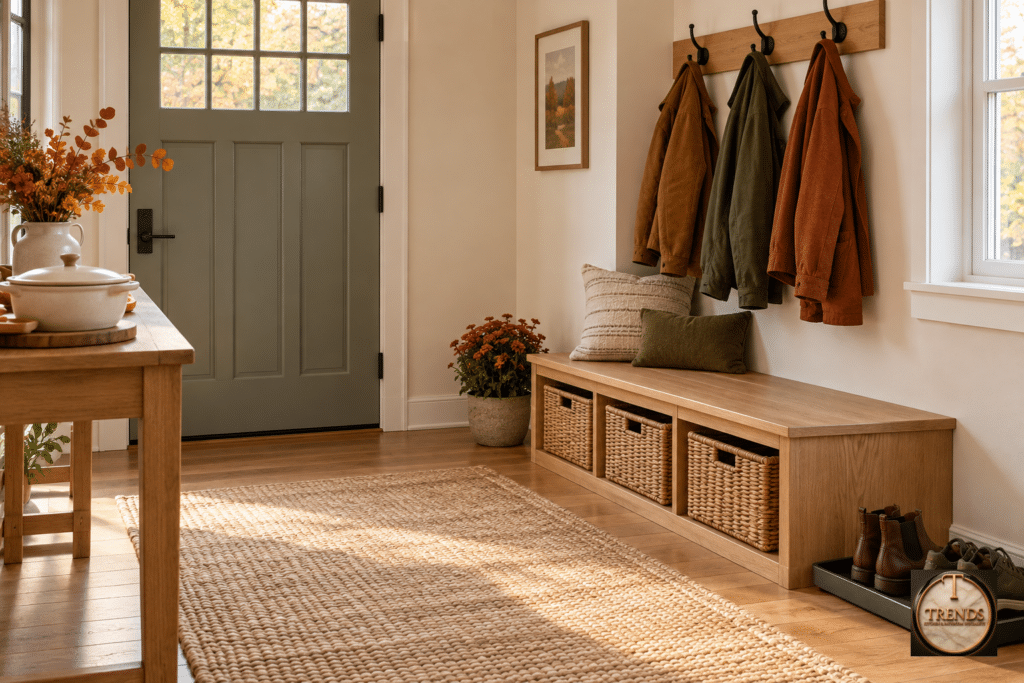
Hooks can also help, provided they are properly installed for the intended use. Do not hang a heavy load from an improvised attachment or install hardware without knowing what is behind the wall. If a permanent hook rail is the answer, choose suitable hardware and have it installed correctly. A small storage improvement should not create a new repair.
Give arriving food a different landing spot
Coats, umbrellas and food do not need to share the same surface. Choose a place where the host can safely receive a dish before helping someone with a coat. It might be a cleared, stable counter near the kitchen rather than a narrow decorative table beside the door.
Protect the surface appropriately for the dish and its temperature. A console designed for keys and mail may not be suited to a heavy hot pan. If the arriving food needs refrigeration or cooking, move it into the food plan promptly instead of leaving it in the entry while everyone catches up.
Tell guests where to go before the doorway gets crowded. A short message such as “bring the dish straight to the kitchen; we'll take your coat” can prevent the awkward balancing act. Make sure the person taking the dish knows where it belongs. A landing place is useful when it connects to the next step.
Make wet-weather storage practical
If boots and umbrellas are part of the day, set out a suitable tray or mat in a location that does not obstruct the door. Choose something stable, with a backing and surface appropriate to the floor. Check it for movement and curled edges before guests arrive.
A small tray may fill quickly. Plan how wet footwear will be arranged without spreading across the hallway, and keep an eye on collected water. Protect the flooring according to its care instructions. Do not leave a wet mat against a surface that should not stay damp simply because the shoes are hidden neatly above it.
Avoid making everyone balance on one foot in a crowded doorway. If shoe removal is your household preference, offer a stable place to sit where possible and help guests who need it. Be flexible about mobility needs. The aim is a welcoming, usable entry, not an obstacle course built around keeping the floor perfect.
Look at the entry after dark
Check the approach, the threshold and the route inside at the time guests are likely to arrive. A porch that looked bright in the afternoon may be quite different after sunset. Make sure existing lighting works and that decorations do not block it or obscure the path.
Inside, the coat area should be easy to find without switching on the brightest light in every room. Look for shadows where a step, rug edge or change of flooring might be difficult to see. Use suitable fixtures and lamps as intended, keeping cords out of traffic.
If the entry regularly lacks useful lighting, note the problem for a licensed electrician. Explain where people need to see and how the switches are used. A permanent lighting plan should support ordinary arrivals as well as holiday company. Do not improvise temporary wiring across the hallway just to illuminate a seasonal display.
Keep the path useful when the house is full
Stand at the door and follow the route to the living room, bathroom and dining area. Remove the package waiting to be returned, the spare chair and the decorative basket if they narrow that route. A hallway that works for one person carrying nothing may not work for guests carrying bags or using mobility aids.
Keep stairs and landings clear. A coat laid on the bottom step is still an object someone has to navigate. Do not use a stair rail as the overflow coat rack, and do not let bags collect where a door needs to open. Check the route again after the first wave of arrivals.
The same applies to leaving. Guests will be searching for keys, matching children's gloves and collecting containers at once. Keep their belongings together where possible, and have a clear spot for take-home items that does not block the exit. Good organization should make the last ten minutes of the visit easier too.
The bedroom pile can still have a plan
Sometimes an existing room is the most practical coat location. If that is your choice, prepare it intentionally. Clear a suitable surface, protect it as needed and keep the room accessible without moving furniture. Decide where bags and personal items should go rather than mixing everything together.
Avoid creating a pile so deep that retrieving one coat means dragging several others onto the floor. A few hangers in an available closet may help. Give guests clear directions, especially if the door will be closed during the gathering. The host should not have to escort every person back through the house.
Respect privacy and access. Keep personal paperwork and items you do not want handled out of the guest area. If the room is needed for someone to rest, choose another location. A coat-storage plan should not make another useful room unavailable when someone needs it.
When the entry needs a permanent change
A holiday can reveal an everyday issue. If shoes block the same door every morning, bags have no home and coats never make it into the closet, record that pattern. A bench, correctly installed hooks, cubbies or a revised closet interior may be worth considering.
Start with the objects and the people using them. How many coats are normally there? Does someone need a place to sit? Where do school bags, dog supplies or work gear go? A built-in that looks tidy but ignores the household's actual load will fill with overflow just like the old arrangement.
Consider door swings, circulation, cleaning and floor durability in the design. Storage depth uses real room space, and a bench can reduce the route if it is placed without care. Measure the area and plan the whole entry before ordering a cabinet. The best solution may be modest, but it should solve the recurring problem.
Reset it while the lesson is fresh
After the guests leave, notice where things ended up despite the plan. If every bag landed on the same chair, that may be where people naturally need a landing spot. If nobody used the closet, was it hard to reach, too full or simply not obvious?
Put temporary pieces away when they are no longer useful, dry and clean the wet-weather area and return household items deliberately. Keep a short note for next time. You do not need a bigger entry every time guests bring more coats; you need to understand what the space is being asked to do.
Our holiday guest-preparation guide follows the other spaces guests use, and home improvements that make sense helps separate a useful small fix from a larger project.
Before company comes, open the closet and walk the route from the front door with your hands full.
Trends Kitchen & Bathroom Specialists
Local source: Kansas City Holiday Boutique.