
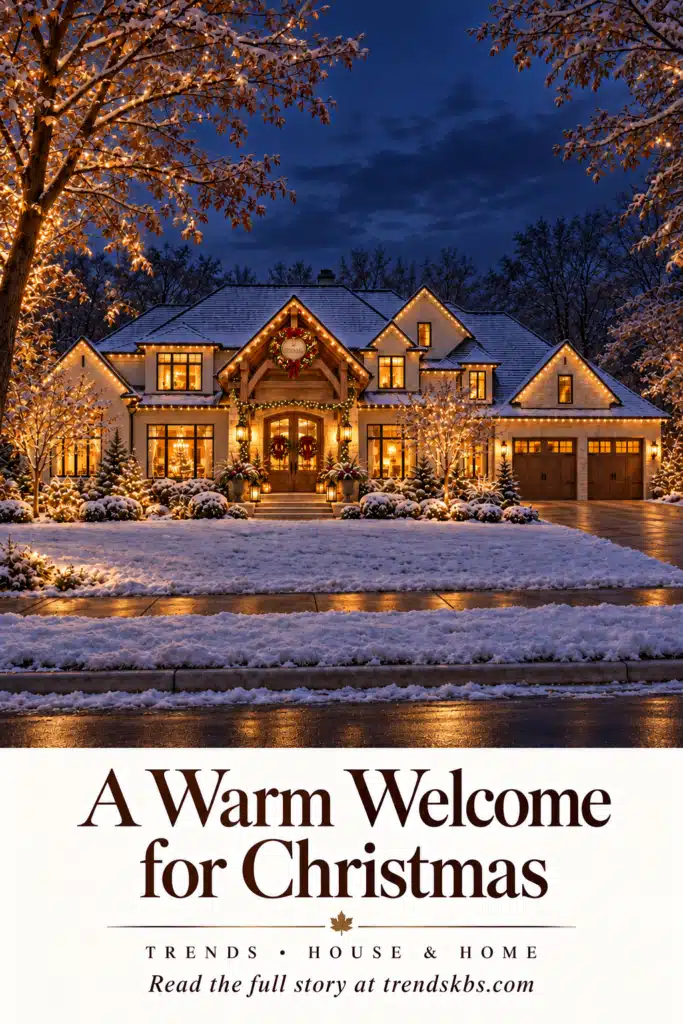
The house does not need to be visible from another county to feel like Christmas. A warm entry, a well-placed wreath, and a few lines of light can make coming home feel special. The best outdoor display also lets you open the door, find the steps, and walk to the house without stepping over a cord.
Start by looking at the architecture. A gabled entry already gives the eye somewhere to go. A porch with columns offers a natural rhythm. A small front door can feel welcoming with one properly scaled wreath and a pair of simple planters. Work with the house instead of trying to cover every surface.
Choose one clear focal point
Stand back at the sidewalk in daylight and choose the place you want people to notice first. Often it is the entry. Keep the largest visual gesture there, then let smaller elements support it.
A wreath tucked into a gable can look beautiful when its scale leaves breathing room around the timber. If it fills every inch of the opening, the architecture and the decoration compete. Test the proportion in a photograph before committing to installation. The wreath should look intentionally hung, not wedged into the house.
You can get a convincing result at ground level too. A door wreath, entry lighting, and a simple arrangement beside the steps may suit the house better than a roofline project. The display you can install and maintain sensibly is the right starting point.
Inventory what you already own
Untangle and inspect lights before you carry anything outside. Set aside damaged equipment for replacement. Read the labels for the actual products: indoor and outdoor use are different, and connection limits are not the same for every string.
Group compatible lights by color and purpose. “Warm white” from one set may look noticeably different beside another. Test the intended combination from a few feet away. A consistent smaller display usually looks calmer than a larger collection that never quite agrees with itself.
Include timers, clips, and extension equipment in the inventory. Buying another box of lights will not solve the problem if you are missing the parts needed to install them correctly.
Plan power and attachment before climbing
Choose equipment rated for its outdoor use and follow its instructions. Have an electrician address unsuitable outlets, damaged wiring, or uncertainty about the supply. Do not solve an electrical problem by hiding it behind greenery.
Use attachment methods intended for the surface and the decoration. Avoid damaging cords or driving fasteners through wiring. Think about wind, rain, and removal, not just how the display looks on a still afternoon.
Elevated installation deserves its own decision. If reaching the proposed location requires unsafe access, use a qualified installer or move the decoration lower. There is no prize for stretching from a ladder to achieve a photograph. Keep the plan within the equipment and skills available.
Keep the arrival route in charge
Open the front door fully and walk the path carrying a large box. Look for decorations that catch on clothing, narrow a step, or hide a handrail. Leave the routes people use clear and visible.
Treat cords as part of the design problem. They should not cross the path where guests walk. Do not pinch them in doors or windows to reach an outlet. A display that depends on either move needs a different location or a different power plan.
Look at the entry after dark from the walking position. Decorative lights do not automatically illuminate a step. Keep functional entry lighting working, even if the holiday lights are prettier. People need to see changes in level, the door hardware, and where to put their feet.
Use the house’s materials as your palette
Warm white light can sit beautifully against natural wood, brick, or stone. Evergreen gives depth without requiring a rainbow of accessories. A burgundy ribbon can provide all the color the entry needs.
For a contemporary house, a restrained repeated shape may feel more natural than an elaborate rustic display. For an older porch, a simple line of greenery can emphasize details already there. Match the decoration to the home you have rather than borrowing every feature from a different style of house.
Try leaving some surfaces undecorated. Darkness and quiet areas help the lighted pieces read clearly. More is not always more welcoming.
Give the display an end-of-evening routine
Use the controls and timers as their manufacturers direct, and establish who checks the display. Revisit it after weather changes. A loose piece or damaged component is a maintenance issue, not something to leave until January because it is inconvenient.
Store the original instructions with the lights. Photograph the arrangement and label the pieces when they come down. Separate damaged items immediately so next year’s decorating does not begin with the same questionable string.
Notice the permanent improvements worth making
If the front steps stay dark, the handrail is loose, or the door is difficult to operate, those concerns belong ahead of a bigger holiday display. Decorations can make a sound entry more inviting. They cannot repair it.
Compare the daytime view with the evening view
Look at the display in daylight before deciding that more light is the answer. Wreaths, ribbons, planters, and the attachment details remain visible when the bulbs are off. A restrained arrangement should feel intentional in both conditions.
Take a photograph from the sidewalk and study the proportions. Does the wreath fit the gable? Does the ribbon overwhelm the door? Are the planters narrowing the approach? A photograph can help you notice the whole composition without being distracted by the effort you put into installing it.
Then look again after dark. Check the actual arrival path, not just the street view. The two views have different jobs. One presents the house; the other helps people enter it comfortably.
Make small adjustments before adding more elements. A better position or a clearer focal point can improve the display more than another string of lights.
Keep the weather in the design conversation
Think about how wind and precipitation affect the chosen pieces. Use products and attachment methods intended for the conditions and the surface. Follow the manufacturer’s instructions rather than improvising because a decorative item happens to fit.
Avoid arrangements that interfere with drainage, ventilation, or the operation of doors and household equipment. The decoration should sit within the house’s ordinary functions, not disable them for the season.
Check the display after significant weather changes from a safe position. If something has shifted or become damaged, address it appropriately. Do not leave a loose item in place because it is difficult to reach.
This is another reason to keep the display manageable. The right scale includes your ability to inspect, maintain, and remove it safely, not just the number of decorations the house can visually hold.
Make removal part of the installation plan
Keep the instructions and spare suitable attachment pieces together. Note where each group of lights belongs and photograph the finished arrangement. If an installer is doing the elevated work, clarify the removal and storage plan at the beginning.
When the season ends, inspect pieces before packing them. Separate damaged equipment so it does not return to next year’s setup. Store lights and decorations according to their requirements and label the groups by location.
A simple note such as “entry gable wreath” or “front porch warm-white set” is more useful than a bin marked only “outside.” Include any information needed to identify compatible replacements.
Do not let a difficult installation become a tradition you dread. If the display was too much work to manage, simplify it next year. A beautiful front door is still a complete holiday welcome.
Let the entry remain recognizably yours
Use the house’s strongest feature and stop before the decoration hides it. Natural timber, a handsome door, brickwork, or a well-proportioned porch can do much of the visual work.
Choose a few seasonal materials that belong with those features. The result can feel rich without being crowded. Leave enough space that the architecture remains visible and the entry remains easy to use.
The best outdoor Christmas display makes you glad to come home. That feeling can begin with a modest wreath in the right place and a light that helps you find the step.
At Trends, we like a seasonal setup that helps a homeowner understand the house. Perhaps the real project is better entry lighting or a more functional landing. Perhaps the house is working well and all it needs is a wreath you enjoy looking at.
Either way, the goal is simple: a welcoming way in, a beautiful view from the street, and a little Christmas waiting when you get home.
Related reading
How to Winterize Your Home Inside and Out: The Complete Kansas City Homeowner Guide (2026)