
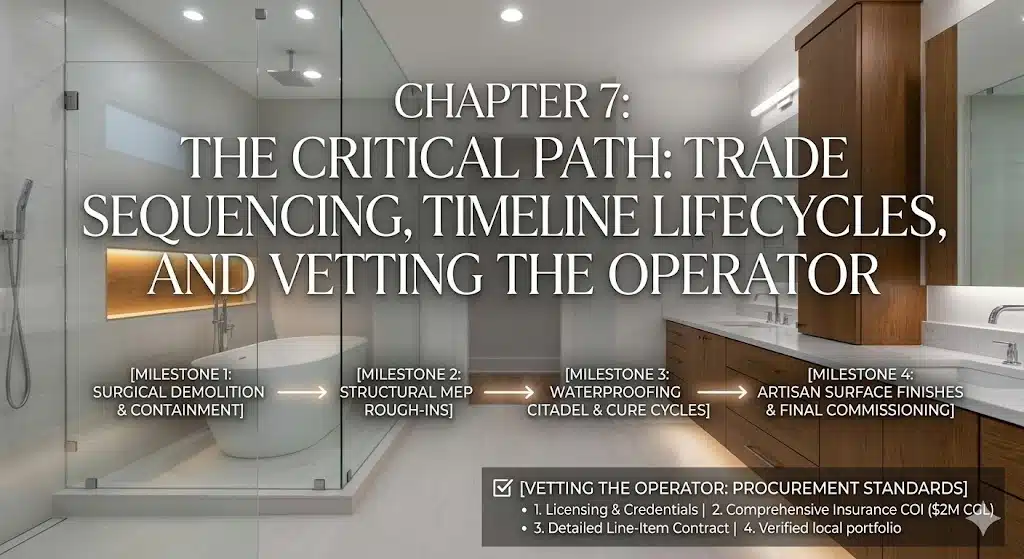
In residential asset underwriting, a luxury bathroom renovation is a highly volatile operational environment, concentrating up to eight unique trades within a minimal physical footprint. A beautiful design is meaningless without a military-grade, field-proven Order of Operations. Neglecting strict trade sequencing triggers cascading schedule failures, failed material warranties, and structural vulnerabilities. Securing capital efficiency requires adherence to the defined Critical Path:
- The Construction Lifecycle Sequence: Execution must flow across five non-negotiable operational phases, prioritizing infrastructure integrity over cosmetic speed:
- Surgical Demolition & Containment (Phase 1): Erecting negative-pressure plastic dust containment and isolating traffic paths, followed by full gut-demolition to the naked studs and subfloor joists to inspect for hidden historical decay.
- Framing & MEP Rough-Ins (Phase 2): Levelling existing structure, integrating hidden blocks for wall-mounted vanities and the signature Grand Infiniti Niche, and deploying 3/4-inch PEX supply trunks and thermostatic valves.
- Waterproofing & Cure Cycles (Phase 3): Leveling subfloors with self-leveling underlayment and installing uncoupling membranes (DITRA) and advanced topical waterproofing systems. This phase strictly mandates uninterrupted chemical cure windows to secure manufacturer performance warranties.
- Artisan Surface Finishes (Phase 4): Slow-setting large-format porcelain or hand-pressed Zellige tiles, packed with stain-resistant epoxy grouts.
- Commissioning & Custom Glass (Phase 5): Mounting high-end white oak cabinetry and sintered stone countertops, concluding with laser measurements for frameless shower doors and hydrostatic pressure tests.
- Underwriting the Operator (Procurement Vetting): Homeowners must secure their capital by auditing prospective general contractors using rigorous procurement standards. Never accept lump-sum quotes; insist on detailed, transparent line-item contracts. Verify Class-level licensure, and mandate the agency-direct delivery of a Certificate of Insurance (COI) confirming a minimum of $1,000,000 to $2,000,000 in Commercial General Liability and active Workers’ Compensation. Only connect with operators who confidently present a verified regional portfolio of complex local transformations in target luxury sectors like Briarcliff, Weatherby Lake, or Tremont.
You have now mastered the seven essential pillars of bathroom capital management. By prioritizing material science, technical precision, operational discipline, and elite transparent craftsmanship over cheap superficial aesthetics, your home’s private wellness sanctuary will seamlessly deliver absolute personal comfort while maximizing your financial terminal value for the next quarter-century.