
CHAPTER 6 SUMMARY: LIGHTING ARCHITECTURE, VENTILATION DYNAMICS, AND THE INVISIBLE COMFORT LOAD
In the architectural planning and financial underwriting of a 2026 luxury bathroom, illumination profiles and mechanical ventilation systems represent the highest source of unplanned line-item budget variances. Homeowners frequently focus capital allocations on visible tile and plumbing assets while starving the room’s hidden atmospheric infrastructure. Protecting your investment and securing high-performance spatial delivery requires a clinical evaluation of modern electrical and thermal engineering loads:
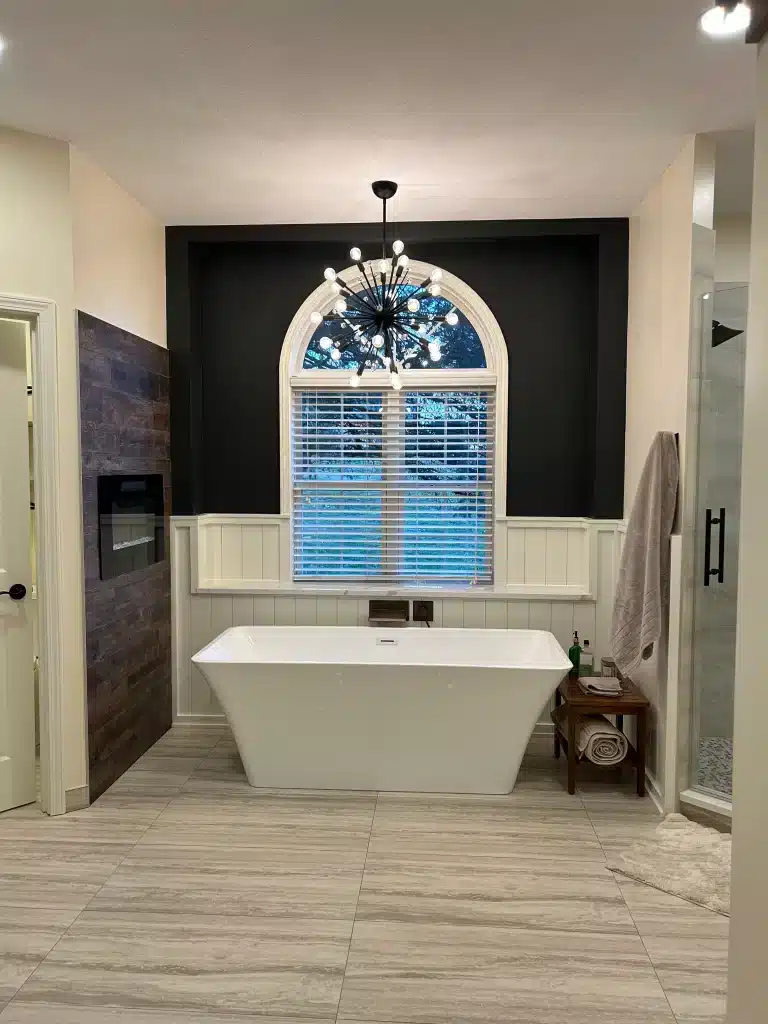
- Layered Lighting Architecture (Perceived Luxury Over Builder-Grade): Modern standards reject single center-mounted fixtures in favor of a synchronized, three-layered illumination strategy. Task lighting prioritizes shadowless facial modeling via LED-integrated, color-tuned smart mirrors ($1,200–$2,500 including recessed block framing). Ambient layers utilize micro-aperture (2-to-3-inch) architectural downlights grouped into independent, dimmable zones. Accent layers deploy low-voltage, waterproof LED channels under floating toe-kicks and inside the upper track of your Grand Infiniti Niche to deliver automated, low-glare navigation. Managing these complex, 8-to-14 fixture multi-zone layouts scales specialized electrical labor and infrastructure costs to $3,500 – $5,500.
- Ventilation Dynamics (CFM Calibration and Asset Protection): To mitigate the severe seasonal humidity shifts of the Midwest, ventilation must be precisely calibrated by Cubic Feet per Minute (CFM) relative to room volume. High-volume steam shower generators and standalone soaking tubs render off-the-shelf exhaust fans useless. High-end frameworks require continuous-run, ultra-quiet inline exhaust systems (Panasonic WhisperCeiling) operating below a silent 0.3 sones, driven by automatic relative-humidity condensation sensors. To eliminate wood decay, proper code compliance demands insulated ducting routed entirely through the roof line or soffit wall, representing an $800 to $1,500 mechanical line item.
- Thermal Floor Engineering (The Radiant Circuit Load): Eliminating winter tile thermal shock requires sub-surface thermal heating mats (Schluter-DITRA-HEAT) integrated directly beneath the floor bed. This assembly pairs an uncoupling crack-isolation membrane with Wi-Fi-enabled smart thermostats. While raw material procurement for a standard 100-square-foot footprint costs roughly $1,200, the true budget driver is routing a dedicated 15-to-20 amp electrical circuit directly back to the main breaker panel to handle the operational current load.
On a regional level, local municipalities spanning from Overland Park to Kansas City, Missouri, mandate rigid National Electrical Code (NEC) compliance, requiring individual Ground Fault (GFCI) and Arc-Fault (AFCI) circuit breakers at the panel to protect wet environments from sub-surface electrical shorts. Within premium Northland communities like Briarcliff, Weatherby Lake, or Tremont, where discerning buyers have a zero-tolerance threshold for moisture decay or poor lighting execution, sensor-driven ventilation and architectural lighting arrays are mandatory structural benchmarks to optimize asset equity and accelerate future resale velocity.